Christian Siefkes

Welcome to my home page!

I am a computer scientist and an author. Currently, I work as a freelance software engineer in Berlin, Germany. I'm especially experienced in database design, development of high-performance and multi-threaded Java applications, and integration of search servers such as Apache Solr. Since early 2012, my most important customer has been Project A, a new incubator for startup companies.

When I don't have to work, I like to write, talk, or research about peer production, free software, open hardware, and commonism. My most well-know works are about commons-based peer production and how to generalize it into the physical world.

I hold a Ph.D. in computer science from the Freie Universität Berlin.

Books

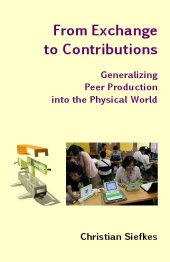
From Exchange to Contributions

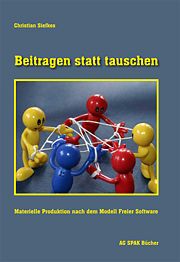
Beitragen statt tauschen

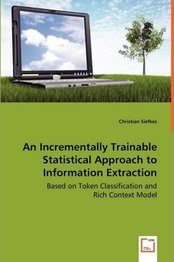
An Incrementally Trainable Statistical Approach to Information Extraction
From Exchange to ContributionsEdition C. Siefkes, Berlin, 2007.

Peer production – the way in which free software projects such as GNU/Linux and free content projects such as the Wikipedia are produced – has revolutionized the areas of software and content production during the last decades. But does peer production only work for information goods, or can it have a similar effect on the production of physical goods?
I have written a book discussing this question, and showing how peer production can indeed grow beyond the sphere of information. A society based entirely on peer production is possible, and this book describes how.

Beitragen statt tauschenAG SPAK Bücher, Neu-Ulm, 2008.

Die deutsche Übersetzung meines Buchs From Exchange to Contributions: das Buch beschäftigt sich dem Potenzial der Peer-Produktion – der Art und Weise wie Freie Software und Freie Inhalte produziert werden. Wir wissen, dass diese neue Produktionsweise von großer Bedeutung ist, wenn es um Software und Inhalte geht – Erfolgsgeschichten wie die von GNU/Linux, Apache oder der Wikipedia sprechen hier eine deutliche Sprache. Aber mein Buch zeigt, dass das noch längst nicht alles ist: Peer-Produktion hat das Potenzial für mehr, bis hin zu einer Umwälzung der gesamten gesellschaftlichen Produktion.

An Incrementally Trainable Statistical Approach to Information
ExtractionVDM Verlag, Saarbrücken, 2008.

My Ph.D. thesis, finished in 2007: The purpose of Information Extraction (IE) is to find desired pieces of information in unstructured or weakly structured texts and store them in a form that is suitable for automatic querying and processing. This book presents a innovative approach to statistical information extraction. It introduces a new algorithm which supports functionality not available in previous IE systems, such as interactive incremental training to reduce the human training effort.
The system also utilizes new sources of information, employing rich tree-based context representations to combine document structure (HTML or XML markup) with linguistic and semantic information. The resulting IE system is designed as a generic framework for statistical information extraction.

What You'll Find on My Site

Free Software

I have contributed to various free software projects, and have also written a few (mostly small) programs of my own. On this page you can also find a list of my translations for the GNU Project and an overview of my experiences in commercial software development.

Free Society

I'm involved in a blog and wiki discussing whether and how the practices of free software and open content development can be extended to other areas of production, and whether an economy based on this mode of production is possible. My research on these questions has lead to a book which is available in English and German. Additionally, this page lists older texts which I wrote as a student, and more.

Spam Filtering

Spam is ubiquitous, highly adapting to any counter-measures, and most annoying. This makes spam filtering one of the most important and interesting research topics in the field of text classification and text mining. Here you'll find my contributions to this effort.

Information Extraction

This page is dedicated to my Ph.D. project. The primary goal of my Ph.D. research was to develop and evaluate a statistical system for the extraction of information from natural language texts that supports incremental training and that takes the structure of texts into account. My Ph.D. thesis, publications, and software are all available here.

History of Computing

As a student I worked for an experimental teaching project with the purpose of giving computer science students a better insight into how to write good papers and to conduct larger research activities. As the topic area of the project we had chosen historical developments in the fields of computer science and software development; both to open up an interesting field of exploration that is largely outside the scope of usual CS teachings and to provide the students with a better understanding of the history of their own field.

Contact

How to get in touch with me.

Keimform Articles

I'm a co-author in the German-language Keimform-Blog, a group weblog discussing whether and in which ways commons-based peer production has a potential that extends beyond the areas of free software and open content production where it has first emerged. Here you can preview my most recent contributions and the latest articles published in the blog by any author.

My Most Recent Articles

Freie Quellen oder wie die Produktion zur Nebensache wurde (Teil 2)

Christian Siefkes, 10 Apr 2013

[Teil 1] Maschen und Trassen Dass die Re/produktion von einer Belastung, der zahllose Menschen einen Großteil ihres Lebens widmen mussten, heute zur relativ mühelosen und meist eher angenehmen Angelegenheit geworden ist, hat auch damit zu tun, dass wir wo möglich auf Maschennetze setzen. Maschennetze (mesh networks) sind dezentrale Netzwerke, die allen die Teilhabe ermöglichen und [...]

Freie Quellen oder wie die Produktion zur Nebensache wurde (Teil 1)

Christian Siefkes, 08 Apr 2013

[Mein Beitrag zum neuen Sammelband „Etwas fehlt“ – Utopie, Kritik und Glücksversprechen der jour fixe initiative berlin (Hg.), erschienen bei edition assemblage (Münster 2013); Lizenz: CC-BY-SA. Der komplette Artikel ist auch als PDF und EPUB verfügbar.] Küchenfabrikation Produziert wird in der Küche oder im Badezimmer. In den meisten Haushalten stehen produktive Automaten. Beliebt ist die [...]

Parecon versus Peer-Produktion Teil 1

Christian Siefkes, 15 Mar 2013

[In den letzten Monaten habe ich mit Michael Albert über Peer Produktion und Participatory Economics, kurz Parecon, als Konzepte einer möglichen Produktionsweise von morgen diskutiert. Brigitte Kratzwald hat erfreulicherweise begonnen, die englischsprachige Diskussion in gekürzter Form ins Deutsche zu übertragen und nach und nach in der Contraste zu veröffentlichen. Dieser erste Teil ist in der [...]

Why I Still Doubt

Christian Siefkes, 17 Feb 2013

[This is part of an debate regarding parecon and peercommony between Michael Albert and me. It is a repy to Michael Albert's Peercommony Doubts Parecon? All articles can be found on the debate overview page – more will follow.] Parecon, like capitalism, is based on paid labor, apparently based on the reasoning that people wouldn’t [...]

Peercommony Reconsidered

Christian Siefkes, 06 Jan 2013

[This is part of an debate regarding parecon and peercommony between Michael Albert and me. It is a repy to Michael Albert's Considering Peercommony. All articles can be found on the debate overview page – more will follow.] Michael formulates various concerns and objections, many of whom are not new to me. I can’t address [...]

My Doubts About Parecon

Christian Siefkes, 19 Dec 2012

[This is part of an debate regarding parecon and peercommony between Michael Albert and me. It is a repy to Michael Albert's Summarizing Participatory Economics. All articles can be found on the debate overview page – more will follow.] While I like the goals of the Parecon, one thing that confuses me is that Parecon, while [...]

Newest Blog Articles

Die Commons-Brille aufsetzen

Stefan Meretz, 21 May 2013

[Artikel aus Oya 20/2013, Lizenz CC by-sa] von Birte Friebel Wie lässt sich Commoning erklären? Die meisten hatten sich vor sieben Tagen erst kennengelernt. Trotzdem steckte vielen beim Abschied von der Commons-Sommerschule ein Kloß im Hals. Eine Woche gemeinsamen Lernens, Wanderns, Singens, Pläneschmiedens hatte eine Gemeinschaft enstehen lassen. Als Jugendliche habe ich mich nie in [...]

Commons im Piraten-Programm

Stefan Meretz, 15 May 2013

Die PIRATEN haben sich ein Programm für die anstehenden Bundestagswahlen gegeben. Darin findet sich auch ein Abschnitt (im Modul 5: Arbeit und Soziales) zu den Commons. Mal sehn, ob andere Parteien nachziehen. So liest sich der Text: Commons (Gemeingüter): Vorfahrt für Kooperation, Selbstorganisation und Gemeinsinn Die Piraten setzen sich dafür ein, Freiräume für Selbstorganisation zu [...]

Commons: Die Verfassung der Gesellschaft jenseits von Markt und Staat

Stefan Meretz, 12 May 2013

Vom 23.-24. Mai findet die Konferenz »Economics and the Commons. From Seed Form to Core Paradigm« in der Heinrich-Böll-Stiftung in Berlin statt. Die internationale Konferenz ist als Einladungsveranstaltung konzipiert und leider nicht allgemein offen. Zur Eröffnung der Konferenz gibt es am 22. Mai 2013 von 16 bis 20:30 Uhr eine öffentliche Veranstaltung mit internationalen Referent*innen (Programm [...]

Repräsentativsystem und Perspektiven weiterer Demokratisierung

Stefan Meretz, 09 May 2013

Ein Diskussionsbeitrag aus dem Arbeitskreis Lokale Ökonomie e.V. (AK LÖK), Hamburg Möglichst viel Demokratie ist allerseits gewünscht. Darauf können sich viele einigen. Bei genauerem Hinsehen nimmt sich eine wirkliche, basisdemokratische Mitwirkung der Menschen an ihrer Gesellschaft bisher freilich eher bescheiden aus. So ist z.B. ein kleiner Teil der Bevölkerung nahezu dauerhaft in einer Sprecherrolle, während [...]

Zum 1. Mai: Film gegen die Arbeitsreligion

Stefan Meretz, 01 May 2013

In seinem Film »Frohes Schaffen — ein Film zur Senkung der Arbeitsmoral« attaktiert Konstantin Faigle einen heiligen Gral: die Arbeit. Ganz unausgewogen, also mit einer deutlichen Haltung, nimmt er die Absurditäten der verrückten Arbeitsgesellschaft auf’s Korn. Ab morgen in deutschen Kinos. In einer Aspekte-Sendung wurde der Film vorgestellt: Update: Im Casablanca Nürnberg gibt’s morgen, 2.5.2013, [...]

Internet Movement and Cybernetic Subversion

Stefan Meretz, 28 Apr 2013

[Part 5 of 5 of the essay »Anti-economics and Anti-politics« by Robert Kurz, published under CC by-nc-sa] One would have to be pretty naïve to assume that a new social movement, under the impact of the crisis, would immediately commence with a radical critique of the commodity production system. It is, rather, more likely that [...]


[Last generated: 2013-05-24] Valid XHTML 1.0 Transitional